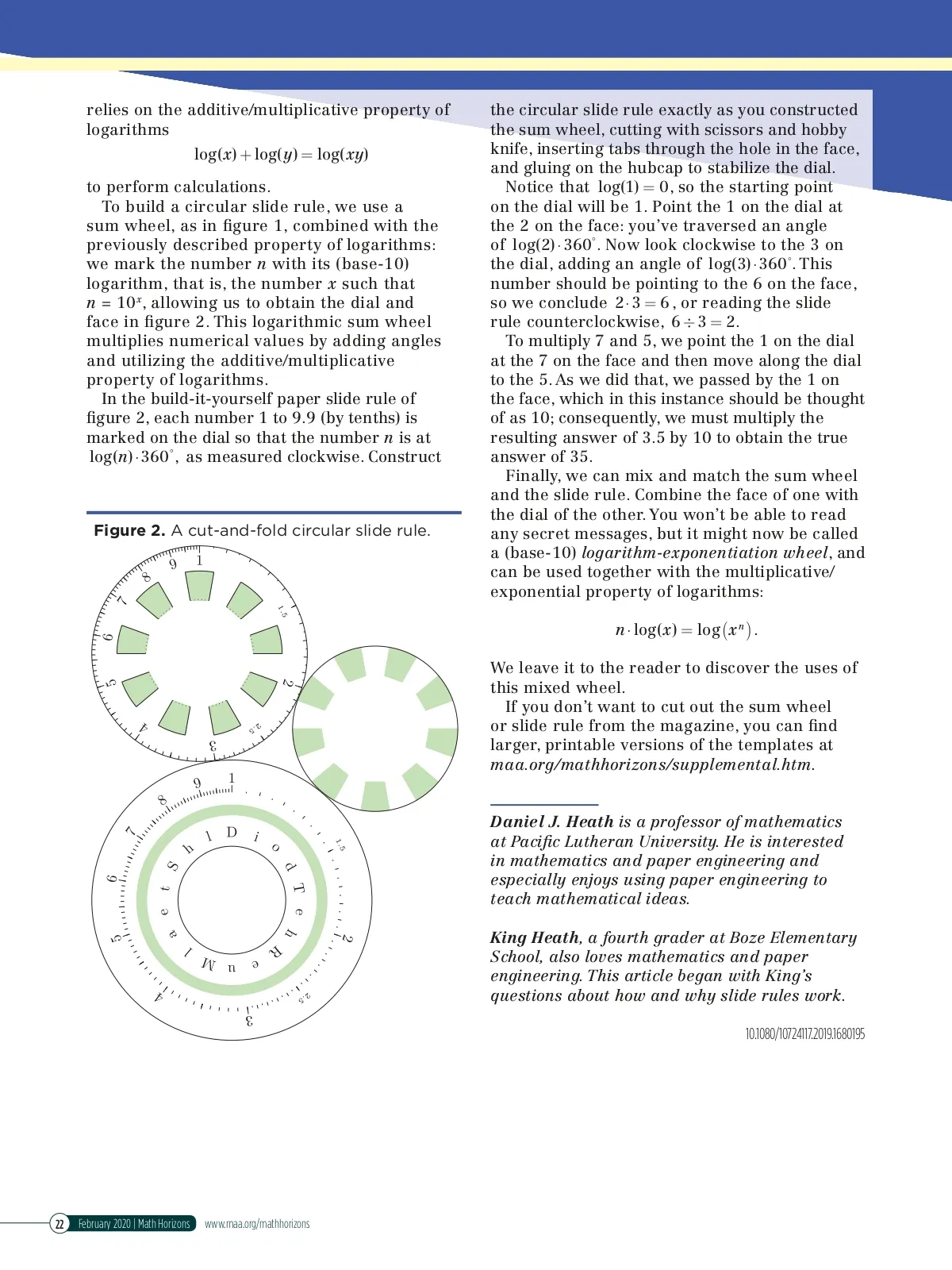
relies on the additive/multiplicative property of logarithms log( xy ) += log( ) log( xy ) to perform calculations. To build a circular slide rule, we use a sum wheel, as in figure 1, combined with the previously described property of logarithms: we mark the number n with its (base-10) logarithm, that is, the number x such that n = 10 x , allowing us to obtain the dial and face in figure 2. This logarithmic sum wheel multiplies numerical values by adding angles and utilizing the additive/multiplicative property of logarithms. In the build-it-yourself paper slide rule of figure 2, each number 1 to 9.9 (by tenths) is marked on the dial so that the number n is at log( n ) ⋅ 360 ° , as measured clockwise. Construct Figure 2. A cut-and-fold circular slide rule. the circular slide rule exactly as you constructed the sum wheel, cutting with scissors and hobby knife, inserting tabs through the hole in the face, and gluing on the hubcap to stabilize the dial. Notice that log( 1 ) = 0 , so the starting point on the dial will be 1. Point the 1 on the dial at the 2 on the face: you’ve traversed an angle of log( 2 ) ⋅ 360 ° . Now look clockwise to the 3 on the dial, adding an angle of log( 3 ) ⋅ 360 ° . This number should be pointing to the 6 on the face, so we conclude 23 ⋅= 6 , or reading the slide rule counterclockwise, 63 ÷= 2 . To multiply 7 and 5, we point the 1 on the dial at the 7 on the face and then move along the dial to the 5. As we did that, we passed by the 1 on the face, which in this instance should be thought of as 10; consequently, we must multiply the resulting answer of 3.5 by 10 to obtain the true answer of 35. Finally, we can mix and match the sum wheel and the slide rule. Combine the face of one with the dial of the other. You won’t be able to read any secret messages, but it might now be called a (base-10) logarithm-exponentiation wheel , and can be used together with the multiplicative/ exponential property of logarithms: nx x n . ⋅= log( ) log () We leave it to the reader to discover the uses of this mixed wheel. If you don’t want to cut out the sum wheel or slide rule from the magazine, you can find larger, printable versions of the templates at maa.org/mathhorizons/supplemental.htm. Daniel J. Heath is a professor of mathematics at Pacific Lutheran University. He is interested in mathematics and paper engineering and especially enjoys using paper engineering to teach mathematical ideas. King Heath , a fourth grader at Boze Elementary School, also loves mathematics and paper engineering. This article began with King’s questions about how and why slide rules work. 10.1080/10724117.2019.1680195 22 February 2020 | Math Horizons www.maa.org/mathhorizons
Math Horizons Volume XXVII, Issue 3, February 2020: Page-22