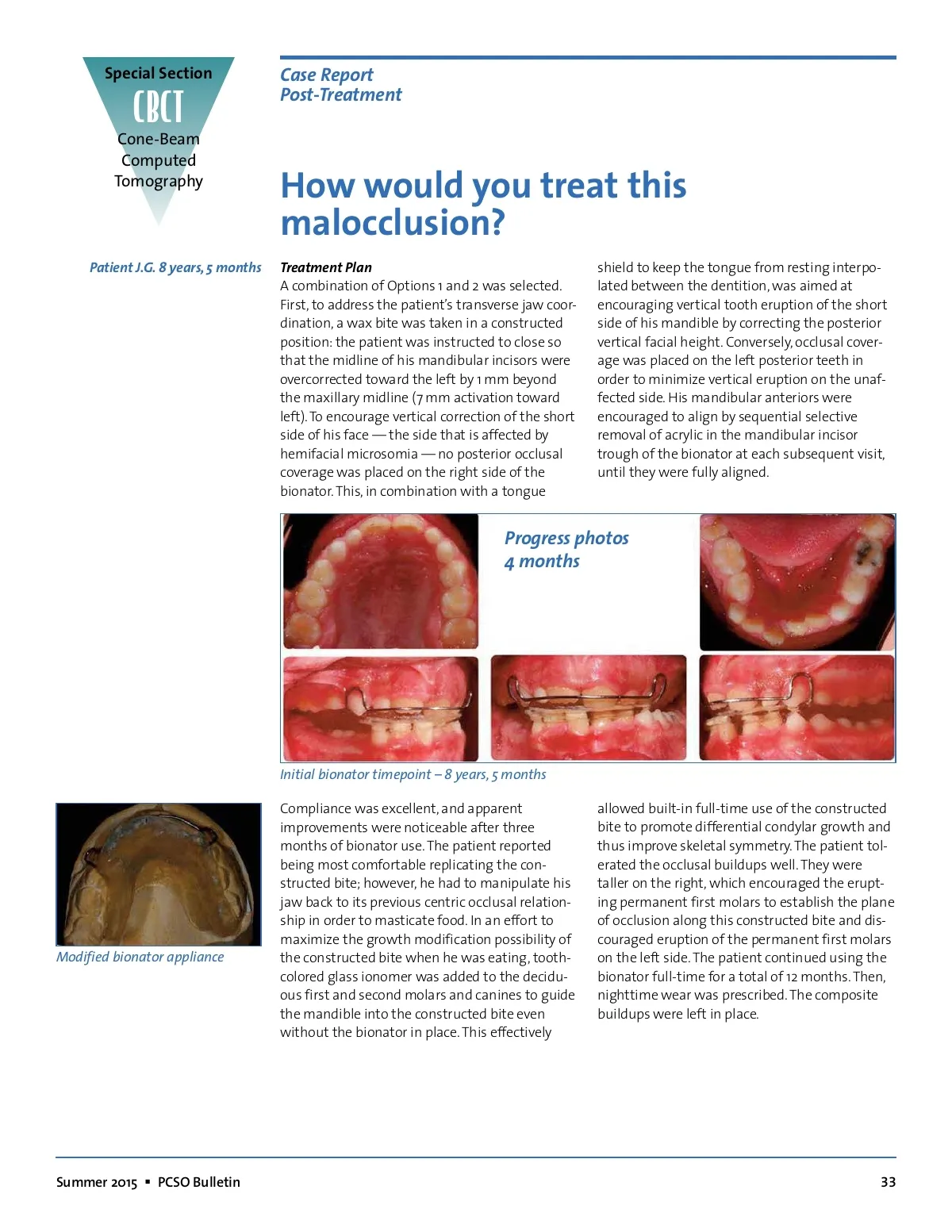
Special Section CBCT Cone-Beam Computed Tomography Case Report Post-Treatment How would you treat this malocclusion? Treatment Plan A combination of Options 1 and 2 was selected. First, to address the patient’s transverse jaw coor-dination, a wax bite was taken in a constructed position: the patient was instructed to close so that the midline of his mandibular incisors were overcorrected toward the left by 1 mm beyond the maxillary midline (7 mm activation toward left). To encourage vertical correction of the short side of his face — the side that is affected by hemifacial microsomia — no posterior occlusal coverage was placed on the right side of the bionator. This, in combination with a tongue shield to keep the tongue from resting interpo-lated between the dentition, was aimed at encouraging vertical tooth eruption of the short side of his mandible by correcting the posterior vertical facial height. Conversely, occlusal cover-age was placed on the left posterior teeth in order to minimize vertical eruption on the unaf-fected side. His mandibular anteriors were encouraged to align by sequential selective removal of acrylic in the mandibular incisor trough of the bionator at each subsequent visit, until they were fully aligned. Patient J.G. 8 years, 5 months Progress photos 4 months Initial bionator timepoint – 8 years, 5 months Compliance was excellent, and apparent improvements were noticeable after three months of bionator use. The patient reported being most comfortable replicating the con-structed bite; however, he had to manipulate his jaw back to its previous centric occlusal relation-ship in order to masticate food. In an effort to maximize the growth modification possibility of the constructed bite when he was eating, tooth-colored glass ionomer was added to the decidu-ous first and second molars and canines to guide the mandible into the constructed bite even without the bionator in place. This effectively allowed built-in full-time use of the constructed bite to promote differential condylar growth and thus improve skeletal symmetry. The patient tol-erated the occlusal buildups well. They were taller on the right, which encouraged the erupt-ing permanent first molars to establish the plane of occlusion along this constructed bite and dis-couraged eruption of the permanent first molars on the left side. The patient continued using the bionator full-time for a total of 12 months. Then, nighttime wear was prescribed. The composite buildups were left in place. Modified bionator appliance Summer 2015 PCSO Bulletin 33
PCSO Bulletin Pacific Coast Society of Orthodontists Bulletin Summer 2015: 33