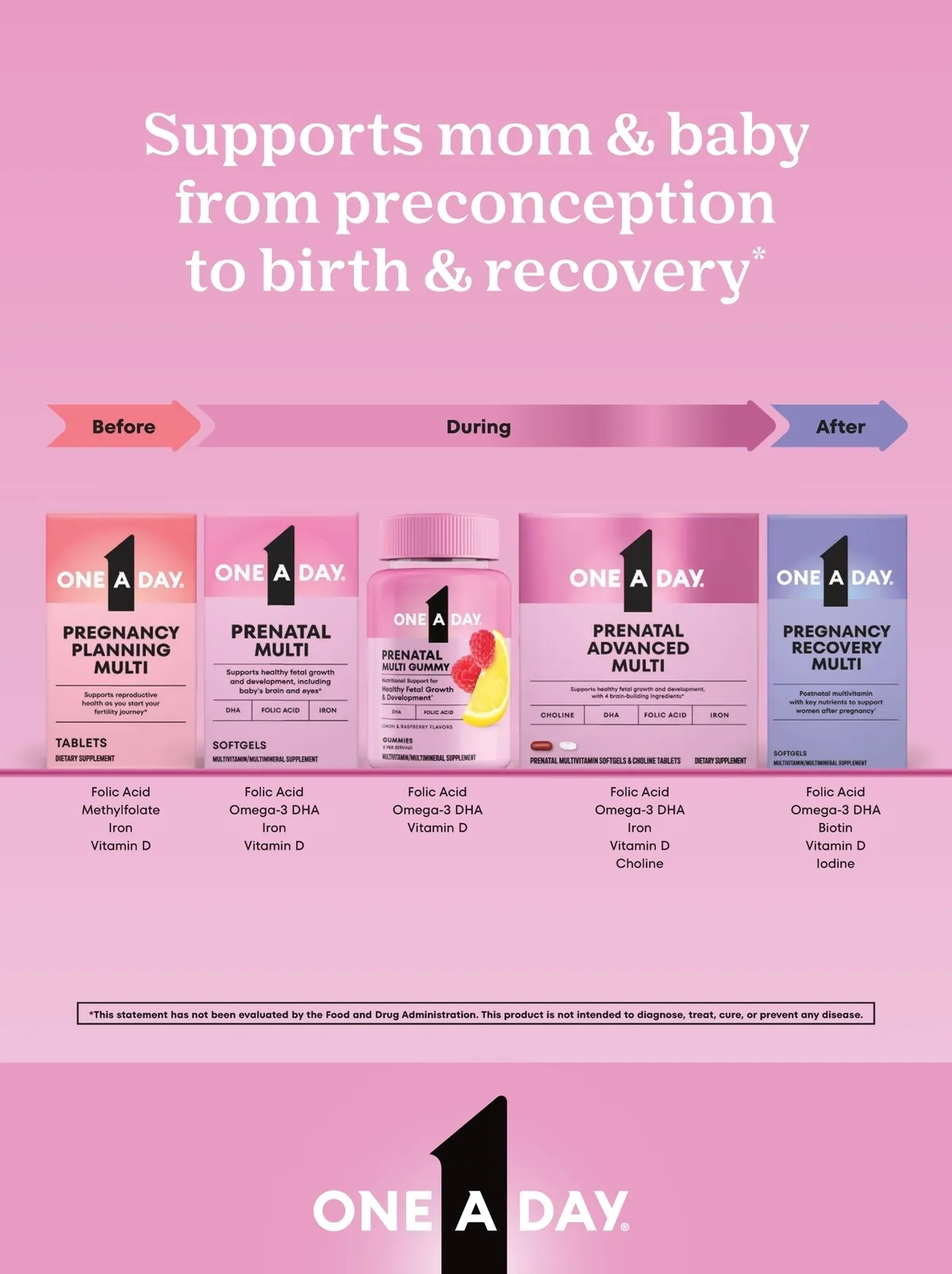
WOMEN’S HEALTH Sponsored by One A Day ® pregnant women due to its widespread inadequacy and the health risks associated with deficiency, such as anemia. Because of this, the American College of Obstetricians and Gynecologists recommends routine screening early in pregnancy and again in the second trimester to monitor iron status. IODINE, CHOLINE, DHA, AND VITAMIN D Additionally, nutrients such as iodine, choline, DHA, and vitamin D are vital for the baby’s development during and after pregnancy. Iodine is essential for thyroid hormone production, which is important for fetal brain develop-ment. Unfortunately, iodine status in the U.S. has declined over the last decades, leaving more women insufficient than before. For this reason, health authorities recommend that prenatal vitamins provide 150 mcg of supplemental iodine. Choline is another a key brain-building nutrient, but less than 10 percent of pregnant and lactating women meet their target intake. To address this, the American Medical Association has encouraged efforts to boost choline levels in prenatal vitamins. Likewise, DHA, an omega-3 fatty acid, is important for the baby’s brain development, while vitamin D plays a critical role in bone development and immune function. Together, these nutrients play a key role in promoting healthy growth and development in babies. GAP NUTRIENTS The gap in nutrient intake is stark. According to the National Health and Nutrition Examination Survey, 9 out of 10 pregnant women in the U.S. fail to meet the basic requirement for key nutrients like iron, vitamin D, choline, and omega-3 fatty acids from food alone. Both pregnancy and breastfeeding increase nutrient demands, requiring higher levels of 19 vitamins and minerals. Many women during the pregnancy journey struggle to meet their daily nutrient needs and fall short in getting enough nutrients such as vitamins A, C, D, E, folate, calcium, iodine, magne-sium, choline, and omega-3 fatty acids from food alone. Every pregnancy is different. I’ve learned that firsthand. But one truth holds across all of them: proper nutrition matters! And to help fill nutrient gaps, consider adding a multivitamin before, during, and after pregnancy. Pharma-cists are uniquely positioned to support women through their pregnancy journey by educating them on the benefits of supplementation, simplifying their choices, and guiding them toward safe and trusted over-the-counter items. Nastaran Faghihnia, PhD, is director of U.S. medical affairs nutritional science at Bayer U.S. Pregnancy journey: Bridging nutritional gaps by Nastaran Faghihnia, PhD As a mother of five, I’ve spent the last decade either pregnant, recovering from pregnancy, breastfeeding, or preparing for another. Despite my deep knowledge of nutrition, I still found myself facing the same challenges many expectant mothers do – managing nausea, chasing toddlers, skipping meals, and often wondering if I was truly meeting my nutritional needs. The reality is that many of us are not. FOLATE The pregnancy journey is a biologically intense period of change. Before the baby bump appears, the body is laying the groundwork by growing the placenta, expanding blood volume, initiating fetal neural development – all of which depend on adequate nutrition. Folate is essential in the earliest weeks of pregnancy, often before a wom-an knows she’s pregnant. This is why the Centers for Disease Control and Prevention recommends all women of reproductive age consume 400 mcg of folic acid daily. Since half of all pregnancies in the U.S. are unplanned, and neural tube development completes just 28 days after conception, folic acid supplementation is recommended at least one month before conception. It’s important to note that many women have a genetic variation that makes converting folic acid into its active form less efficient. Methylfolate, the active form of folate, can be readily used by the body. Adequate folate intake is critical to prevent neural tube defects in the developing fetus, such as spina bifida. IRON As pregnancy progresses, the demand continues to grow. Iron needs dramatically rise to support increased mater-nal blood volume and fetal growth and development. The recommended daily intake for iron in pregnant women is 27 mg. Iron is a nutrient of public health concern for 34 America’s PHARMACIST | October 2025
America's Pharmacist October 2025: Page 34